Mezovest Limited
Re-engineered a legacy fintech monolith into scalable services, and built internal tools for the supply business.
- Role
- Software Engineer
- When
- Jan 2024 – Jul 2026
- Where
- Lagos, Nigeria
- Stack
- TypeScript, Python, Go, RabbitMQ, Docker, Kubernetes, PostgreSQL, GitHub Actions
The context
Mezovest runs fintech and energy-supply products. The core platform had grown into a legacy monolith that was hard to scale and slow to release. [ADD: team size and who you worked with]
What I built
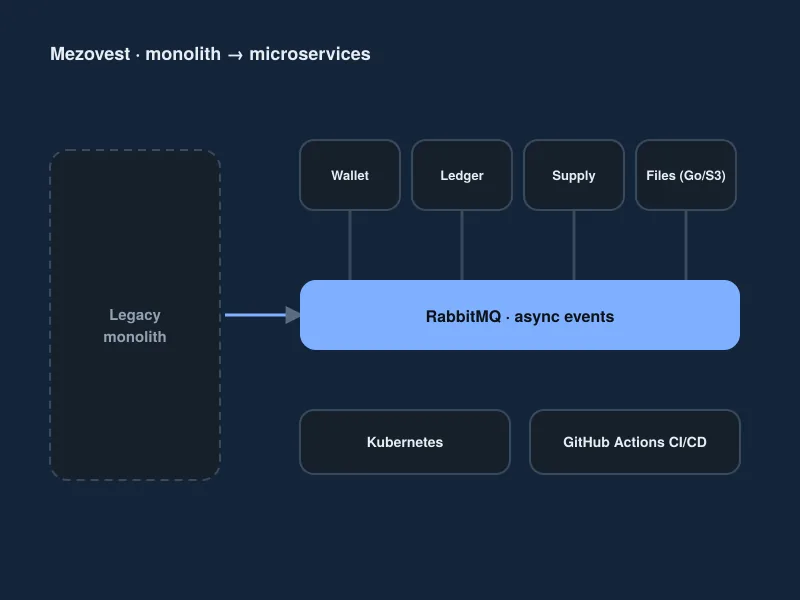
- Led the re-engineering of the legacy fintech monolith into TypeScript and Python microservices.
- Designed distributed services on RabbitMQ for asynchronous processing of financial transactions and reporting workflows.
- Containerized and deployed services with Docker and Kubernetes for consistency and scale.
- Implemented CI/CD with GitHub Actions, cutting about 20 minutes from each deployment.
- Built secure services with role-based access control for internal supply-management applications.
- Built a Go file repository service on Amazon S3 for secure storage and sharing with stakeholders.
A hard problem
[ADD: one tricky problem you solved here: what broke or was unclear, the options you weighed, what you chose and why. Two short paragraphs is plenty.]
Results
- Roughly 2× system efficiency after the move to microservices.
- About 20 minutes saved on every deployment, with less release complexity.
What I'd do next
[ADD: one improvement you'd make with more time. It shows judgment.]